

expert reviews trifold RFID blocking front pocket wallet for men durable modern design 2026
Expert Trifold RFID Wallet Review: Durable 2026 Guide
What Makes a Trifold Wallet RFID-Safe for Modern Carry
When you are evaluating expert reviews trifold RFID blocking front pocket wallet for men durable modern design 2026, understanding the technology matters more than trusting marketing claims. Genuine RFID protection operates at the 13.56 MHz frequency at which contactless credit cards, passports, and access badges transmit data. A properly shielded wallet creates a Faraday cage that blocks electromagnetic signals from reaching your cards when the wallet is closed.
How RFID Blocking Works at 13.56 MHz Frequency
RFID-blocking material (typically a metallic mesh or carbon-fiber layer) interrupts the radio waves that scanners use to read your cards. Bull Guard integrates this shielding across all three panels of the trifold, ensuring coverage whether you carry two cards or twenty. The blocking layer sits between the leather and the card slots, invisible but functional.
Faraday Cage Shielding Across All Three Panels
A trifold's folded design naturally creates multiple barriers. Quality wallets position RFID material to cover every card slot and ID window. When you close the wallet, the overlapping panels form a complete shield. When you open the wallet, your cards become readable again for checkout or badge access.
Testing RFID Protection: Simple Home Verification Methods
Place a contactless credit card inside the closed wallet and hold it against a payment terminal. If the terminal does not detect the card, the blocking works. For work badges, try unlocking a door through the closed wallet. RFID Developer Duck ran a scanner test and reported that Bull Guard blocks 100% of signals. This DIY approach beats trusting product descriptions alone.
The Trade-Off: Blocking Work Badges vs. Contactless Cards
Effective RFID blocking means you must open your wallet to tap your card or scan your badge. For professionals who swipe building access cards dozens of times daily, this adds seconds to each interaction. The Freedom Trifold addresses this issue with dual ID windows and thumb cutouts for quick access. You decide whether the security benefit outweighs the convenience trade-off based on your daily routine and risk tolerance.
Trifold Organization: Balancing Capacity With Front-Pocket Fit

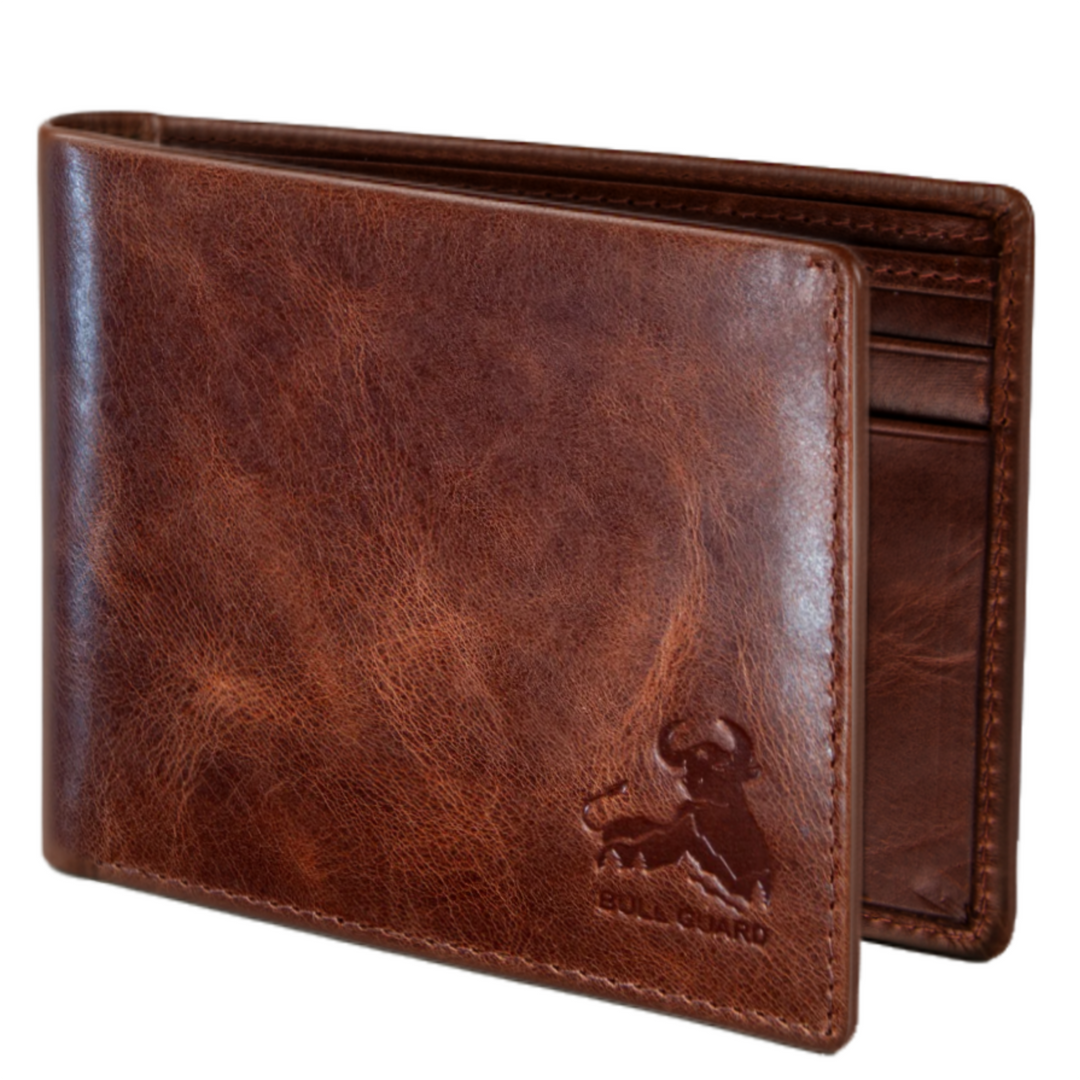
The best expert reviews trifold RFID blocking front pocket wallet for men durable modern design 2026 solve a specific problem: carrying everything you need without creating a bulky back-pocket bulge. Bull Guard trifolds measure about 3.2" × 4.1" when closed, slim enough for front-pocket carry yet spacious enough for 12+ cards, multiple bills, and small essentials. Discover similar great options like the Bifold with Flip Up ID for an alternative organizational style.
Dual ID Windows and Thumb Cutouts for Quick Access
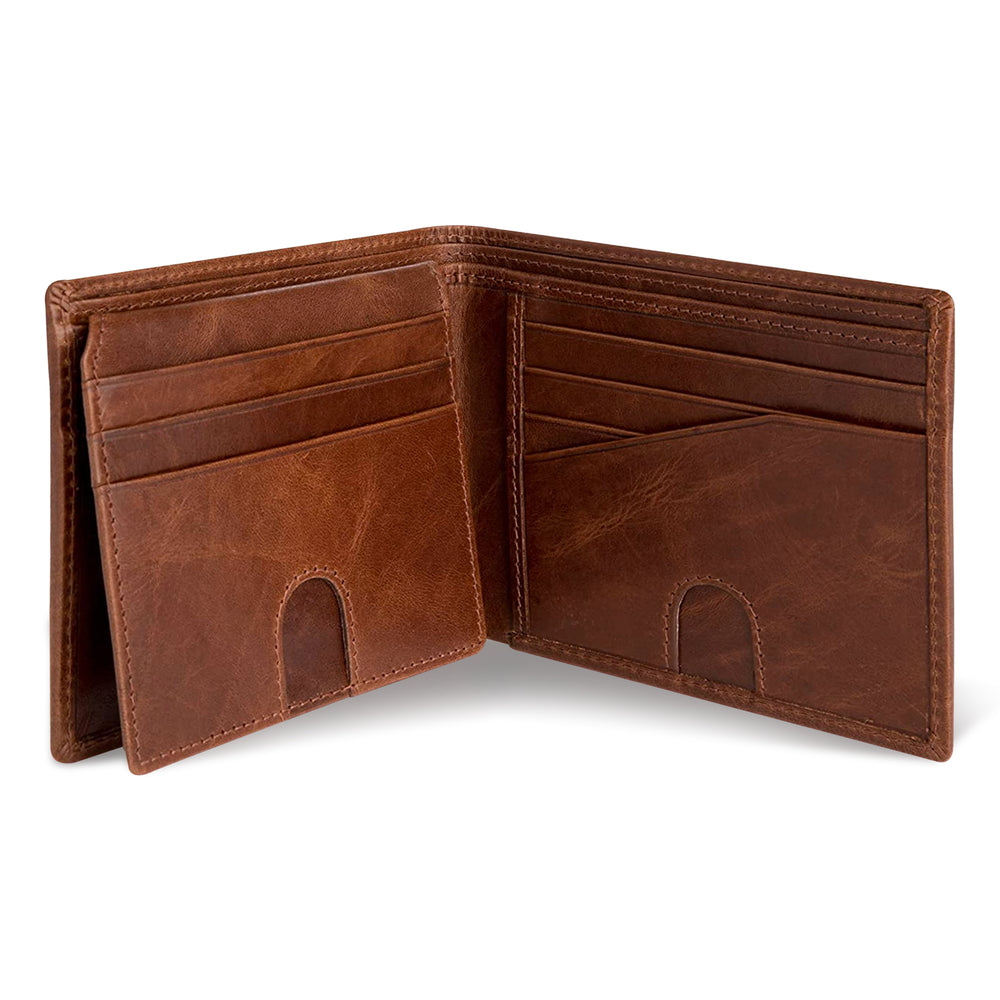
The Classic Trifold includes one clear ID window. The Freedom Trifold includes two ID windows with precision cutouts, ideal for professionals carrying both a driver's license and a work badge. Thumb cutouts on card slots let you push cards up from below rather than digging fingernails into tight leather slots. This design detail matters after months of daily use when other wallets' slots become stretched or torn.
Separated Bill Pockets and Hidden Sleeves for Security
Dual bill compartments let you separate denominations or keep receipts apart from cash. Both the Classic and Freedom Trifolds include a secret pocket tucked inside the cash section, large enough for an AirTag, an emergency $100 bill, or a backup house key. Gifting Jack uses his to secure a folded insurance card. This hidden space adds versatility without advertising its presence.
Card Slot Design: Anti-Slip Tolerances and Smooth Retrieval
Bull Guard designs card slots with snug-yet-smooth tolerances that secure cards without binding. Each slot is cut to grip the card edge lightly, preventing accidental slips when you open the wallet but releasing cleanly when you apply thumb pressure. The leather's natural break-in refines this balance over the first few weeks: slots that feel firm at first loosen just enough to let you slide cards out with one hand while still holding them securely in your pocket.
Thumb cutouts positioned at the base of each slot make retrieval easy. Instead of pinching a card corner or digging with your fingernail, you press upward from below and the card rises into your grip. This detail saves time during transactions and reduces wear on both the card and the leather. After months of daily use, the cutouts remain crisp and the slots retain their shape because the stitching anchors each compartment independently.
Dimensions That Work: From 3.2" × 4.1" to 8.1 cm × 10.4 cm
Bull Guard trifolds measure approximately 3.2 inches wide by 4.1 inches tall when closed, or roughly 8.1 cm by 10.4 cm. Unfolded, the wallet extends to about 9.8 inches (24.9 cm) in width, revealing all three panels at once. These proportions fit comfortably in a front pocket without creating a bulge or pressing against your hip when you sit. Thickness varies by leather type and how many cards you carry, typically ranging from 0.6 to 0.9 inches (1.5 to 2.3 cm) when moderately loaded.
Compared to bifolds that can exceed 4.5 inches in height, the trifold's compact vertical dimension keeps the profile low in your pocket. The three-panel fold distributes card layers horizontally rather than stacking them vertically, which reduces front-to-back thickness even when you carry eight or nine cards. This geometry makes the trifold a strong pick for men who prefer front-pocket carry but need more organization than a minimalist card case can provide.
Genuine Leather Quality: Beyond the Grade Label
The leather industry uses terms like "full-grain," "top-grain," and "genuine leather" to describe how hides are processed, not to assign absolute quality rankings. Full-grain leather retains the outermost layer of the hide with all its natural texture and pores, while top-grain leather has been lightly sanded to remove imperfections before finishing. Both can deliver strong durability and beauty when sourced from premium hides and skilled tanneries. The term "genuine leather" confirms the material is real animal hide, and quality can vary widely depending on the tannery's standards and methods.
Think of it like restaurants: the cut of meat matters, but the chef, ingredients, and preparation determine the final result. A mediocre tannery can produce disappointing full-grain leather, while a master tannery can create top-grain leather that outlasts and outperforms lower-grade full-grain. Bull Guard partners with trusted tanneries that select premium hides, use time-tested tanning methods, and finish each piece to exacting standards. This approach helps ensure the leather in your hands feels supple yet strong, develops character over time, and withstands years of daily carry.
Full-Grain vs. Top-Gain: Processing Terms, Not Absolute Rankings
Full-grain leather preserves the hide's natural surface, including minor scars, pores, and grain variations that tell the story of the animal's life. This untouched surface absorbs oils from your hands and develops a rich patina faster than sanded leathers. Top-grain leather undergoes light surface correction to create a more uniform appearance, then receives a protective finish that resists stains and moisture. Neither is universally "better"; full-grain appeals to those who prize natural character and rapid patina, while top-grain suits users who want consistent color and easier maintenance.
Bull Guard offers both types because real-world performance depends on the entire supply chain. A trifold wallet made from carefully selected top-grain leather by a reputable tannery can outlast a full-grain wallet cut from lower-quality hides or poorly tanned stock. When you hold a Bull Guard trifold, judge by the leather's hand feel, the evenness of the dye, the tightness of the stitching, and the smoothness of the fold lines. These tangible qualities reveal more about longevity than any grade label alone.
Tannery Expertise and Hide Selection Drive Real Durability
A skilled tannery begins with hides from mature animals raised in climates that produce tight, dense fiber structures. The tanning process stabilizes these fibers using vegetable tannins, chromium salts, or a combination of both, transforming raw hide into leather that resists decay, water, and abrasion. Finishing steps add color, texture, and protective coatings, but the foundation is always the quality of the hide and the precision of the tanning chemistry.
Bull Guard works with tanneries that maintain strict quality controls at every stage. Hides are inspected for thickness consistency, fiber density, and minimal defects before tanning begins. The result is leather that flexes thousands of times without cracking, holds stitching securely, and ages gracefully. You can feel this difference immediately: premium leather has weight without stiffness, a smooth surface without a plasticky coating, and a subtle grain texture that catches the light naturally.
Crazy Horse, Buffalo, and Napa Leather: Sensory and Performance Differences
Crazy Horse leather is full-grain cowhide treated with waxes and oils that create a distressed, vintage look from day one. When you scratch or bend it, lighter tones emerge from beneath the darker surface, giving the wallet a rugged, lived-in character. This finish is forgiving: scuffs blend into the patina rather than standing out as flaws. Crazy Horse feels slightly waxy to the touch and develops a soft hand quickly, making it ideal for users who want immediate character and low-maintenance care.
Buffalo leather comes from water buffalo hides, which have a coarser, more pronounced grain than cowhide. The fibers are denser and more resistant to stretching, so buffalo wallets hold their shape firmly even when filled with cards and cash. The texture is bolder and more tactile, appealing to those who want a wallet that looks and feels distinct. Buffalo leather takes longer to break in but rewards patience with strong durability and a unique aesthetic.
Napa leather is top-grain cowhide finished to a smooth, supple texture. It feels softer and more refined than Crazy Horse or Buffalo, with a consistent surface that takes dye beautifully. Napa wallets slide easily in and out of pockets, resist creasing during the break-in period, and maintain a polished appearance over years of use. This finish suits professionals who want understated elegance and a wallet that looks appropriate in both casual and formal settings.
Patina Development: How Quality Leather Ages Beautifully Over Years
Patina is the natural darkening, softening, and sheen that develops as leather absorbs oils from your hands, exposure to sunlight, and the friction of daily carry. After three months, a Bull Guard trifold begins to show subtle color shifts in high-contact areas: the outer panels darken slightly, fold lines become more defined, and the leather softens noticeably. By one year, the wallet has molded to your pocket's contours and the cards you carry most often, creating a custom fit that a new wallet cannot replicate.
After three or more years, the patina reaches full maturity. The leather develops a deep luster, scratches blend into the overall character, and the wallet feels like an extension of your hand. This aging process is a mark of quality: cheap leather cracks, peels, or loses its finish, while premium leather becomes more beautiful and more comfortable. Bull Guard wallets are designed to be companions that improve with time, not disposable accessories that degrade after a season.
Durability That Lasts: Stitching, Structure, and Everyday Confidence
Strong stitching forms the foundation of any wallet that survives years of daily use. Bull Guard trifolds use reinforced thread at stress points where the leather folds and where card slots anchor to the main body. Each stitch penetrates the leather at a consistent depth and spacing, creating a bond that distributes tension evenly rather than concentrating it at weak points. This prevents a common failure mode of cheaper wallets, in which stitching unravels at corners or seams after a few months of pocket friction.
The thread itself matters as much as the stitching pattern. Bull Guard selects bonded nylon or polyester thread that resists abrasion, moisture, and UV exposure better than cotton or rayon alternatives. When you examine the seams closely, you will see tight, uniform stitches with no loose loops or skipped sections. This precision signals a manufacturing process that prioritizes longevity over speed, a choice that pays dividends when your wallet enters its second or third year of front-pocket carry.
Strong Stitching as the Foundation of Longevity
Reinforced stitching at fold lines prevents the leather from tearing when you open and close the wallet dozens of times per day. Bull Guard runs double or triple stitches along these high-stress zones, creating a buffer that absorbs mechanical strain. The stitching also locks each compartment in place, so card slots do not shift or sag over time. After months of use, the wallet maintains its original geometry because the thread holds every panel exactly where it was positioned during assembly.
Customer testimonials confirm this durability in real-world conditions. One user reported daily back-pocket carry for more than 18 months, noting the wallet still looked new with no fraying, loose threads, or structural compromise. Another described replacing a carbon-fiber slim wallet that failed quickly and found the Bull Guard trifold sturdy and reliable by comparison. These stories reflect the engineering principle that proper stitching multiplies the leather's inherent strength rather than relying on the hide alone to resist wear.
Reinforced Compartments and Card Slot Precision
Each card slot in a Bull Guard trifold is constructed as an independent compartment with its own stitching perimeter. This modular approach means that if one slot experiences heavy use, the stress does not transfer to adjacent pockets. The leather edges inside each slot are finished smooth to prevent snagging, and the stitching runs close enough to the edge to secure the layers without creating a bulky ridge that interferes with card insertion.
Precision in card slot dimensions ensures cards slide in and out cleanly without binding or flopping loose. Bull Guard calibrates these tolerances during prototyping, testing with standard credit cards, driver's licenses, and thicker cards like hotel keys. The result is a slot that grips firmly enough to prevent cards from falling out if the wallet is inverted but releases smoothly when you apply thumb pressure from the cutout below. This balance remains stable through the break-in period because the stitching anchors the slot walls and prevents them from stretching unevenly.
Real-World Testing: Months and Years of Front-Pocket Carry
Bull Guard prototypes undergo field testing on city streets, mountain trails, and daily commutes before reaching production. Designers carry test wallets in front pockets through varied climates and activities, monitoring how the leather responds to sweat, temperature swings, and constant friction against denim or khaki fabric. This hands-on approach reveals weak points that lab tests might miss, such as corner wear from repeated insertion into tight pockets or stress on the center fold from sitting with the wallet positioned at an angle.
Users report wallets that remain functional and attractive after years of service. One customer noted his Bull Guard trifold survived months of contractor work without the leather or stitching showing signs of failure. Another appreciated that the wallet's color and build quality stayed consistent despite heavy daily use. These outcomes support the brand's commitment to testing under authentic conditions and refining designs based on how people actually carry and use their wallets.
Warranty and Repair Philosophy for Well-Made Products
Bull Guard backs its trifolds with a warranty that reflects confidence in materials and construction. The brand's approach treats each wallet as a long-term investment rather than a disposable item, offering support if manufacturing defects appear. This philosophy aligns with the broader ethos of creating products that reduce waste by lasting longer and performing better than mass-market alternatives.
When you calculate cost per year, a Bull Guard trifold priced between $30 and $100 that serves you for five or more years costs far less annually than replacing $20 wallets every 12 to 18 months. The math favors quality: fewer purchases mean less environmental impact, less frustration with failed products, and more time enjoying a wallet that feels better in your hand with each passing season.
Choosing Your Trifold: Styles, Colors, and Use Cases

Bull Guard offers two core trifold designs, each tailored to different organizational needs. The Classic Trifold features one ID window and a straightforward layout that appeals to users who value simplicity and timeless styling. The Freedom Trifold includes dual ID windows with thumb cutouts, designed for professionals who carry multiple badges or licenses and want fast access without unfolding the wallet completely. Both models include a secret pocket in the cash compartment, ideal for stashing an AirTag, emergency cash, or a backup ID during travel.
Your choice depends on how you use your wallet daily. If you frequently present a work badge and driver's license, the Freedom Trifold's dual windows save time and reduce fumbling. If you prefer a clean, classic aesthetic and carry one primary ID, the Classic Trifold keeps the focus without extra features you will not use. Both wallets share the same RFID protection, leather options, and durable stitching, so your decision centers on layout rather than compromising on security or longevity. For other RFID-protected options, explore the Camo Bifold Leather Wallet that blends rugged style with security.
Classic Trifold for Timeless Simplicity and 1 ID Window
The Classic Trifold appeals to men who appreciate traditional wallet design refined for modern carry. One ID window displays your most-used card, whether a driver's license, transit pass, or employee badge. The remaining slots organize credit cards, insurance cards, and membership cards in separated compartments that prevent stacking and make retrieval quick. The secret pocket in the bill section adds a layer of security for items you want hidden from casual view.
This model suits users who value understated elegance and do not need multiple visible IDs. The single-window design keeps the wallet's profile slim and the visual aesthetic clean. Customers often choose the Classic Trifold as a gift because its straightforward layout works for nearly anyone, from recent graduates to retirees, without requiring explanation or adjustment.
Freedom Trifold with Dual ID Windows for Professionals and Badge Carriers
The Freedom Trifold addresses the specific challenge faced by professionals who juggle work credentials, driver's licenses, and access cards. Two ID windows with thumb cutouts let you display and access both cards without opening the wallet fully. This feature helps during security checks, building entry, or traffic stops, when you need to present multiple forms of identification quickly and confidently.
Badge carriers, health care workers, government employees, and frequent travelers benefit most from this layout. The dual windows eliminate the need to dig through card slots or unfold panels repeatedly, reducing wear on the leather and saving time during each interaction. The Freedom Trifold maintains the same compact dimensions as the Classic model because the second ID window replaces a standard card slot rather than adding bulk.
AirTag-Ready Secret Pockets for Travel and Security
Both Bull Guard trifolds include a hidden sleeve within the cash compartment that can fit an Apple AirTag or similar tracking device. This pocket sits flat against the bill section, adding negligible thickness while providing peace of mind if your wallet is misplaced or stolen. Travelers use this feature to monitor their wallet's location through crowded airports, unfamiliar cities, or beach outings where they prefer carrying minimal cash and cards.
The secret pocket also serves as secure storage for emergency cash, a spare house key, or a folded backup ID. Its concealed position means casual observers are unlikely to notice the compartment even if they handle the wallet. This design detail reflects Bull Guard's philosophy of anticipating real-world needs and integrating solutions without complicating the user experience.
Leather Color and Logo Options: From Forest Brown to Blue, Branded or Clean
Bull Guard trifolds come in multiple leather finishes and color choices, from classic forest brown and rich black to distinctive blue and turquoise tones. Each color is available across leather types, so you can pair Crazy Horse's vintage texture with a bold blue hue or choose Napa's smooth finish in understated brown. This variety lets you match your wallet to your personal style, whether you prefer rugged outdoor aesthetics or refined professional polish.
Branding options include the iconic Bull logo, an eagle emblem, a snake design, or a completely clean face with no logo. The brandless option appeals to minimalists who want the wallet's leather and craftsmanship to speak for themselves without external symbols. This flexibility lets you select a wallet that fits your identity and daily context, from corporate environments to creative studios to weekend adventures.
Strong stitching forms the foundation of any wallet that survives years of daily use. Bull Guard trifolds use reinforced thread at stress points where the leather folds and where card slots anchor to the main body. Each stitch penetrates the leather at a consistent depth and spacing, creating a bond that distributes tension evenly rather than concentrating it at weak points. This prevents a common failure mode of cheaper wallets, in which stitching unravels at corners or seams after a few months of pocket friction. This test report demonstrates the effectiveness of shielding materials commonly used in card sleeves and wallets.
Strong Stitching as the Foundation of Longevity
Reinforced stitching at fold lines prevents the leather from tearing when you open and close the wallet dozens of times per day. Bull Guard runs double or triple stitches along these high-stress zones, creating a buffer that absorbs mechanical strain. The stitching also locks each compartment in place, so card slots do not shift or sag over time. After months of use, the wallet maintains its original geometry because the thread holds every panel exactly where it was positioned during assembly.
Customer testimonials confirm this durability in real-world conditions. One user reported daily back-pocket carry for more than 18 months, noting the wallet still looked new with no fraying, loose threads, or structural compromise. Another described replacing a carbon-fiber slim wallet that failed quickly and found the Bull Guard trifold sturdy and reliable by comparison. These stories reflect the engineering principle that proper stitching multiplies the leather's inherent strength rather than relying on the hide alone to resist wear.
Reinforced Compartments and Card Slot Precision
Each card slot in a Bull Guard trifold is constructed as an independent compartment with its own stitching perimeter. This modular approach means that if one slot experiences heavy use, the stress does not transfer to adjacent pockets. The leather edges inside each slot are finished smooth to prevent snagging, and the stitching runs close enough to the edge to secure the layers without creating a bulky ridge that interferes with card insertion.
Precision in card slot dimensions ensures cards slide in and out cleanly without binding or flopping loose. Bull Guard calibrates these tolerances during prototyping, testing with standard credit cards, driver's licenses, and thicker cards like hotel keys. The result is a slot that grips firmly enough to prevent cards from falling out if the wallet is inverted but releases smoothly when you apply thumb pressure from the cutout below. This balance remains stable through the break-in period because the stitching anchors the slot walls and prevents them from stretching unevenly.
Real-World Testing: Months and Years of Front-Pocket Carry
Bull Guard prototypes undergo field testing on city streets, mountain trails, and daily commutes before reaching production. Designers carry test wallets in front pockets through varied climates and activities, monitoring how the leather responds to sweat, temperature swings, and constant friction against denim or khaki fabric. This hands-on approach reveals weak points that lab tests might miss, such as corner wear from repeated insertion into tight pockets or stress on the center fold from sitting with the wallet positioned at an angle.
For a deeper understanding of RFID technology and its applications, including challenges of durability and environment, the environmental standards and durability considerations are critical insights for wallets that include RFID blocking.
Users report wallets that remain functional and attractive after years of service. One customer noted his Bull Guard trifold survived months of contractor work without the leather or stitching showing signs of failure. Another appreciated that the wallet's color and build quality stayed consistent despite heavy daily use. These outcomes support the brand's commitment to testing under authentic conditions and refining designs based on how people actually carry and use their wallets.
Warranty and Repair Philosophy for Well-Made Products
Bull Guard backs its trifolds with a warranty that reflects confidence in materials and construction. The brand's approach treats each wallet as a long-term investment rather than a disposable item, offering support if manufacturing defects appear. This philosophy aligns with the broader ethos of creating products that reduce waste by lasting longer and performing better than mass-market alternatives.
When you calculate cost per year, a Bull Guard trifold priced between $30 and $100 that serves you for five or more years costs far less annually than replacing $20 wallets every 12 to 18 months. The math favors quality: fewer purchases mean less environmental impact, less frustration with failed products, and more time enjoying a wallet that feels better in your hand with each passing season.
To learn more about the fundamental technology behind RFID and its uses beyond wallets, consider reading the Radio-frequency identification article for a comprehensive overview.
My take as Marcela (Bull Guard Founder & Chief Storyteller): When I read expert reviews trifold RFID blocking front pocket wallet for men durable modern design 2026, I look for the quiet details that show up after the first hundred carries: fold integrity, stitch discipline, and a layout that makes everyday movement feel steady. That is the standard I build for at Bull Guard—carry life boldly, and let your wallet keep pace.